Tag: Water cycle

The importance of the water cycle || Science Class

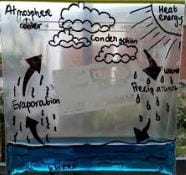
Hello everyone, welcome to another blog post about science. Today, we learned why the water cycle is important and participated in an interesting activity. In this blog, I will share six reasons why the water cycle is vital, followed by a description of the activity we did related to evaporation, condensation, precipitation, and runoff. The picture below shows what we created. Our project is currently displayed on our classroom window, which enhances our understanding of the water cycle we made.

Enjoy this blog post!


Why is the water cycle important?

The water cycle is incredibly important for many reasons. Here are 6 reasons:

1)Provides fresh water

It ensures that we have a constant supply of fresh water to drink, cook with, and use in our daily lives. Without the water cycle, we would run out of clean water very quickly!


2) Helps Plants Grow:

Plants need water to grow. Through precipitation, the water cycle delivers the necessary water to plants, helping them to flourish. This is essential for producing the food we eat, the oxygen we breathe, and maintaining the natural beauty of our environment.


3) Regulates Weather and Climate: 

The water cycle plays a crucial role in regulating the Earth’s weather and climate. The process of evaporation and condensation helps to distribute heat around the globe, influencing weather patterns and keeping our planet’s temperature balanced.


4) Supports all living things:


Every living thing, from tiny insects to giant whales, depends on water to survive. The water cycle ensures that water is available to all forms of life, providing habitats for animals and helping ecosystems thrive.


5) Cleans and Filters Water:

As water moves through the cycle, it goes through natural filtration processes. When water evaporates, it leaves impurities behind, and when it seeps through the ground, it gets filtered by soil and rocks. This natural cleaning process is vital for maintaining the purity of our water sources.


6) Drives the Earth’s system
The water cycle is interconnected with other natural cycles, like the carbon cycle and nitrogen cycle. It helps to drive these systems, ensuring that nutrients are cycled through the environment, supporting life and maintaining the health of our planet.


Activity –

Materials:

Ziploc bag, water, blue food colouring, a permanent marker, and tape.

Steps:

  1. Draw a sun, clouds, and waves on the outside of the bag with the marker. Add process names.
  2. Fill the bag with a small amount of water and add a few drops of blue food colouring.
  3. Seal the bag tightly and tape it to a sunny window.
  4. Observe over a few days as the water evaporates, condenses on the sides of the bag, and then “rains” back down. We will look at these more next week.

This is what it’s supposed to look like
Thanks for reading my blog

Shreeya

The Water cycle || Science Class

Hello everyone, welcome back to my blog. Today in science, we learnt about ‘The water cycle’.


Achievement Objective:

Planet Earth and Beyond: Earth Systems – Investigate the water cycle and its effect on climate, landforms, and life.

Learning Objective: 

Students will describe the stages of the water cycle and create a diagram that accurately represents these stages.


Water

Liquid –

  • Rain
  • Hail
  • Snow
  • Sleet

Solid

  • Ice

Gas

  • Steam
  • Water Vapour


Water cycle

If all the water on Earth is continually cycled in this way, with no ‘new’ water being created, where did all the water on Earth come from originally?

What is the water cycle?

The water cycle describes how water evaporates from Earth’s surface and the oceans because of the heat from the Sun, rises into the atmosphere, where it cools and condenses into rain or snow in clouds, and falls back to the ground as rain, hail and snow.


Understanding the water cycle

Rain is a natural phenomenon that is linked to the water cycle, a continuous process that regulates the distribution of water on Earth. 

The water cycle, the processes of evaporation, condensation, and precipitation that occur to maintain the Earth’s water balance. Rain is a direct result of the water cycle, serving as a vital component of this natural process.

The water cycle is like a big, magical loop that keeps water moving around our Earth. Let’s follow a drop of water on its amazing journey.


Evaporation

Imagine you’re outside on a sunny day. The sun shines down and warms everything up. When the sun’s heat warms up rivers, lakes, and oceans, the water starts to change. It turns into a gas called water vapour. This process is called evaporation. It’s like when you see steam rising from a hot pot of water.


Condensation

As the water vapour rises up into the sky, it gets cooler. When it gets cool enough, it changes back into tiny drops of water. This is called condensation. These tiny drops come together to form clouds. So, clouds are really just made up of lots of little water drops!


Precipitation

Now, the clouds are floating around, full of water drops. When the clouds get too heavy with all that water, the drops fall back down to Earth. This falling water is what we call precipitation. Precipitation can be rain, snow, sleet, or hail, depending on the temperature. If it’s warm, we get rain. If it’s cold, we might get snow.


Collection

Once the water falls to the ground, it needs to go somewhere. It collects in rivers, lakes, and oceans. Some of it soaks into the ground and becomes part of the underground water supply. Plants and trees also drink up some of this water to grow.


Ace, Pro, Legend – Questions

legend

1. Explain in detail the water cycle.
The water cycle is the continuous movement of water on Earth. It starts with evaporation, where sunlight heats up water in rivers, lakes, or oceans, turning it into water vapour. Then, the vapour rises and cools, leading to condensation, where it forms tiny water droplets that come together to create clouds. When these clouds become too heavy, the water falls back to Earth as precipitation, which can be rain, snow, sleet, or hail. Finally, the water collects in rivers, lakes, and oceans, ready to start the cycle all over again.

2. Describe two ways water enters our atmosphere.
Water enters our atmosphere mainly through evaporation, where water from oceans, lakes, and rivers turns into vapour due to the heat from the sun. Another way is through transpiration, where plants release water vapour into the air from their leaves.

3. Why do the sea levels not drop when water is evaporated from it?
Sea levels don’t drop because the water that evaporates eventually falls back to Earth as precipitation. Plus, water cycles between different forms (like gas and liquid) and doesn’t disappear, it just changes form.

4. Where does water come from?
Most of the water on Earth comes from the early days of our planet when it formed. Some of it came from comets and asteroids hitting Earth, while some was released from volcanoes. Today, the water on Earth is recycled through the water cycle, meaning we are using the same water that has always been here.


Thanks for reading,

Shreeya