Tag: Wk 2

Chinese New Zealanders || Social Studies

Hello everyone, welcome back to my blog.

For the last two weeks of this term (weeks 1 and 2), I have been learning about Chinese New Zealanders. To start it off, we first had to choose either Ace Pro or Legend of Titan. I picked Titan, knowing that I could do it.

In my social studies class, my tasks were to:
1. Watch a video of Chinese teenagers talking about coming to Aotearoa.
2. Read about Chinese New Zealanders.
3. Complete our follow-up tasks related to the article (Step 2).

We also had to watch a video on how to write a PEEL paragraph. Then, we made a copy of two documents: one document discussed why parents should set a bedtime for their kids, and the second one compared the experience of coming to New Zealand in the past to now in 2025.

After completing both activities, we had to blog about our work.

In this blog post, I will be sharing my social studies work. I will explain what PEEL is and answer the question: Why do people decide to immigrate to Aotearoa?

Enjoy this blog! I hope you find it informative and learn something new today.


What is PEEL?

P: Point
  • It introduces the topic of the paragraph and states the main idea or argument clearly and concisely. 
E: Evidence/Example
  • This can include facts, statistics, quotes, or specific examples to prove the point. 
E: Explanation
  • It demonstrates your understanding and shows the reasoning behind your argument. 
L: Link
  • It either summarises the point, connects it back to the essay’s thesis, or provides a smooth transition to the next paragraph. 


Social Studies

This is my social studies task – Copy of Titan


Question

Why do people decide to immigrate to Aotearoa?

People decide to immigrate to Aotearoa for various reasons, but a common reason is the pursuit of better economic opportunities. New Zealand has a strong economy with a demand for skilled workers in sectors such as technology, healthcare, and agriculture, attracting immigrants looking for stable employment. Additionally, the country offers a high quality of life, including a robust healthcare system, excellent education, and a safe environment, which appeals to families seeking a better future for their children. Cultural diversity is also a significant draw, as Aotearoa embraces multiculturalism, allowing immigrants to maintain their traditions while integrating into society. Furthermore, many individuals relocate to escape political instability, persecution, or adverse living conditions in their home countries, finding in New Zealand a welcoming and peaceful environment. Overall, the combination of economic prospects, quality of life, and cultural acceptance makes Aotearoa an attractive destination for many immigrants.


That’s all for my blog

Thanks,

Shreeya
Relief Music Activities || Music Class

Hello everyone, welcome back to my blog.

Today in music class, the teacher wasn’t here, so the relief teacher asked us to create some songs using Suno AI. After we finished our projects, we could choose to do some relief activities. Out of all the options, I completed two activities. One was about Diwali, and the other focused on movie music.

This blog post is dedicated to sharing what I learned from those two activities.

Enjoy!

Task –

Music Activities

Thanks, that’s all for this post

Bye, Shreeya


Liquids || Science Class

Hello everyone, welcome back to my blog. I’m excited to share my latest insights from science class. Today, we learnt about liquids. In this blog post, I’ll explore what I learned about liquids, their properties, and their importance in our everyday lives. From water to various types of beverages, liquids play a crucial role in countless processes and activities. Hope you learn something new today while reading this blog post.

Enjoy!


Learning Intention: Explore the properties of liquids


What is a liquid?

A liquid is a state of matter that can flow and take the shape of its container. Unlike solids, liquids do not have a fixed shape, but they do have a fixed volume


How do liquids behave?

Flow and shape

  • Liquids flow easily and can be poured
  • They always take the shape of the bottom of their container
  • Think of how milk spreads out in a bowl

Fixed Volume

  • Liquids keep the same amount, no matter the container
  • If you pour 100ml of juice into a cup or a bowl, it’s still 100ml
  • Liquids do not expand to fill the whole space like spaces


Properties of liquids

Can flow

  • Liquids move and can be poured from one place to another. This is called flowing

Takes Shape

  • liquids take the shape of their container but do not change their volume

Visible Surface

  • liquids have a clear, visible surface called the meniscus


Particles in liquids

In liquids, particles are close together but can slide around each other. This movement lets liquids flow and take the shape of their container.


Compare: Liquids and Solids

Liquid

  • Flows and takes the shape of its container
  • Fixed volume
  • Particles move past each other

Solids

  • Keeps its own shape
  • Fixed volume
  • Particles packed tightly, only vibrant


Experiment (if we did it)

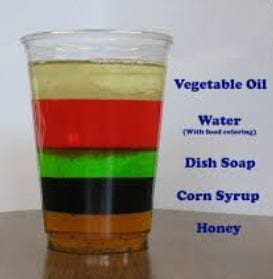
Aim: To look at why some liquids float on top of other liquids


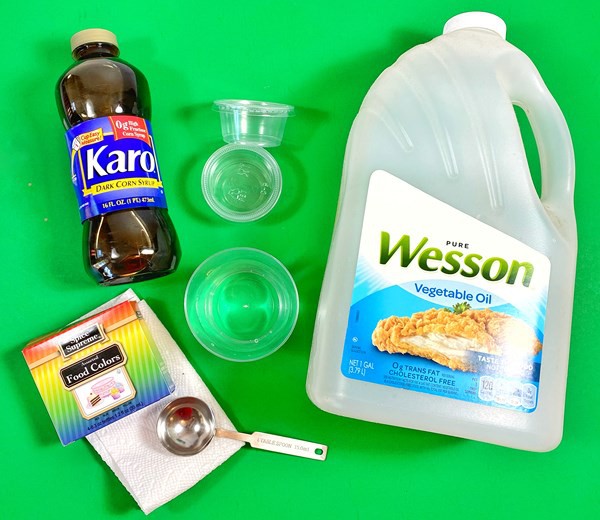
Materials:

  • Glass or cup
  • Tap water
  • Food colouring
  • Scissors
  • RUler
  • Rubber band (wide)
  • Small piece of wax
  • Craft stick
  • Small, clear jars or transparent mini cups (2~oz) with lids (at least 2)
  • Permanent marker
  • Masking tape
  • Small piece of Styrofoam
  • Tablespoons (3)
  • Dark corn syrup
  • Vegetable oil


Instructions:

  1. Take a clean tablespoon (tbsp) and pour 1 tablespoon of dark corn syrup into cup 1.
  2. With the second tablespoon, carefully pour 2 tbsp of coloured water into cup 1 on the tip of the corn syrup.
  3. Use the third clean tablespoon to pour 2 tbsp of vegetable oil into cup 1 on top of the coloured water
  4. Now take an empty cup 2 and add the same liquids, but reverse order. Start by pouring 2 tbsp of vegetable oil.
  5. Next, add 2 tbsp of coloured water on top.
  6. With a fresh tablesoon, carefully pour 1 tbsp of dark corn syrup into cup 2 on top of the water.
  7. Wait 1 or 2 minutes to let all the liquids settle in cups 1 and 2. Then look at both cups are compare how the different liquids are layered.
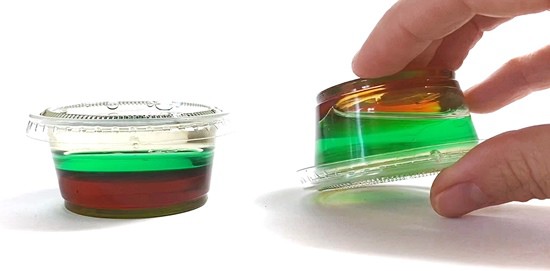
  8. Now take a cup 1 and close it with a lid. Carefully turn it upside down and set it on the table again. Observe the different liquids.
  9. Compare the upside-down cup 1 with cup 2 after a couple of minutes.
  10. Get all your cup-up objects and your penny ready, and drop the penny into cup 2
  11. Next, take the piece of rubber band and rip it into cup 2 with the craft stick, pushing the rubber band piece all the way down to the bottom of the cup. Make sure it does not stick to the bottom and can float freely.
  12. Now drop the piece of wax into cup 2 again, push the wax all the way down into the cup with the craft stick, but make sure it does not stick to the bottom or to the sides of the cup. It should be able to float freely.
  13. Last, take the piece of styrofoam and drop it into cup 2. Submerge it with the craft stick and wait for it to settle in one of the layers.
  14. Look at all four objects that you dropped into cup 2, and compare their locations.
  15. Finally, take cup 1, which is still upside down, and shake it really hard. Be sure to hold the lid tight. then pback on the table ( this time, right side up). Observe what happens for about 5 to 10 minutes

materials needed for stacking liquid density science activityTwo mini cups filled with dark corn syrup, green water, and vegetable oil are placed next to each other. A hand turns one of the mini cups upside down.

Rainbow Dish – Chromatography  (experiment)

Aim: To look at the density of skittles when mixed in water.

Materials: 

  • Pertri Dish
  • Water
  • Skittles

The experiment will be done in groups of 2. You will need to use the Skittles to see how the sugar in Skittles prevents them from mixing.


Method:

  1. I set up the experiment by placing all the skittles around the edge of the petri dish.
  2. Water was poured into the middle of the petri dish.
  3. I watched as the colours of the skittles flowed separately to form a colour wheel.


Thanks for reading

Shreeya

Instructional/Procedural Writing || Literacy

Instructional/Procedural Writing: Literacy

Hey everyone, Happy Red Nose Day.

Over the past 2 days, we’ve been learning about instructional and procedural writing, which is all about giving clear instructions. Have you ever had to write or follow instructions before? In this blog post, I’m going to talk about what instructional writing is, share the task I worked on, and reflect on how it went. Hope you enjoy it!


If you’ve ever followed a recipe, built a model, or played a new game, you’ve probably read some instructions. These types of writing are super important because they help people understand how to do things step-by-step.


What is Instructional Writing?

Instructional writing is all about telling someone how to complete a task or activity. It’s like being a guide. Imagine you’re teaching a friend how to make a sandwich or how to play your favourite video game. That’s instructional writing.

This type of writing can take many forms, such as:

  • Recipes: Instructions for making food.
  • How-to Guides: Step-by-step directions for completing a task.
  • User Manuals: Instructions for using a product or software.

Task –

For the task, we were given four options to choose from, and I decided to explain how to play the classic game “Connect Four.” As I began writing about it, I found joy in the process of writing someone how to play a game. It was interesting to break down the strategies, making it easier for new players to understand the game.

Here are the options we had to pick, the one in bold is the one I picked.

Tell me in the comments what you would pick and why.

Procedural / Writing Instructions List


Task Notes Suited for
1. Recipe – Using your own words, write up a procedure for writing your favourite recipe. Think of a common dish or main meal that you like at home. 

Also, be sure to include some pictures.

Draft by yourself.

Ace, Pro, Legend, Titan
2. How to make Fairy Bread Use the template provided to help lay out your work. Ace, Pro, Legend, Titan
2. Moving around – Using your own words, write up a procedure for moving from the TV in T4 to Mrs Fletcher’s space (T2) Before you start writing, walk the route that you will take to get to Mrs Allan’s space. Consider directional vocabulary, including ‘turn,’ ‘left,’ ‘right,’ and ‘straight.’ Draft with a buddy. Ace, Pro, Legend, Titan
3. Paper plane – Using your own words, write a set of instructions for creating a paper plane. Choose your favourite board game. Come up with a set of instructions for how to play this game so that someone else can follow it. Legend, Titan
4. Board game instructions Choose your favourite board game. Come up with a set of instructions for how to play this game so that someone else can follow it. Legend, Titan

My Connect 4 Writing


Reflection –

I hope you enjoyed this blog post as much as I did. The task was quite straightforward, and I found it enjoyable to complete. I look forward to my class learning more about instructional writing in the upcoming weeks.

Thanks for reading my blog post, and I hope you found this informative and interesting.

Bye,

Shreeya