Tag: Māori

Kai – Social Studies

Hello everyone, welcome back to my blog. This week, my class has been learning about kai, which means food in Māori culture. We read stories and articles exploring the fascinating history and various aspects of kai, which I found incredibly interesting.


What is Kai?Kai Waho | Maori Cuisine, Cultural & Wilderness Experience
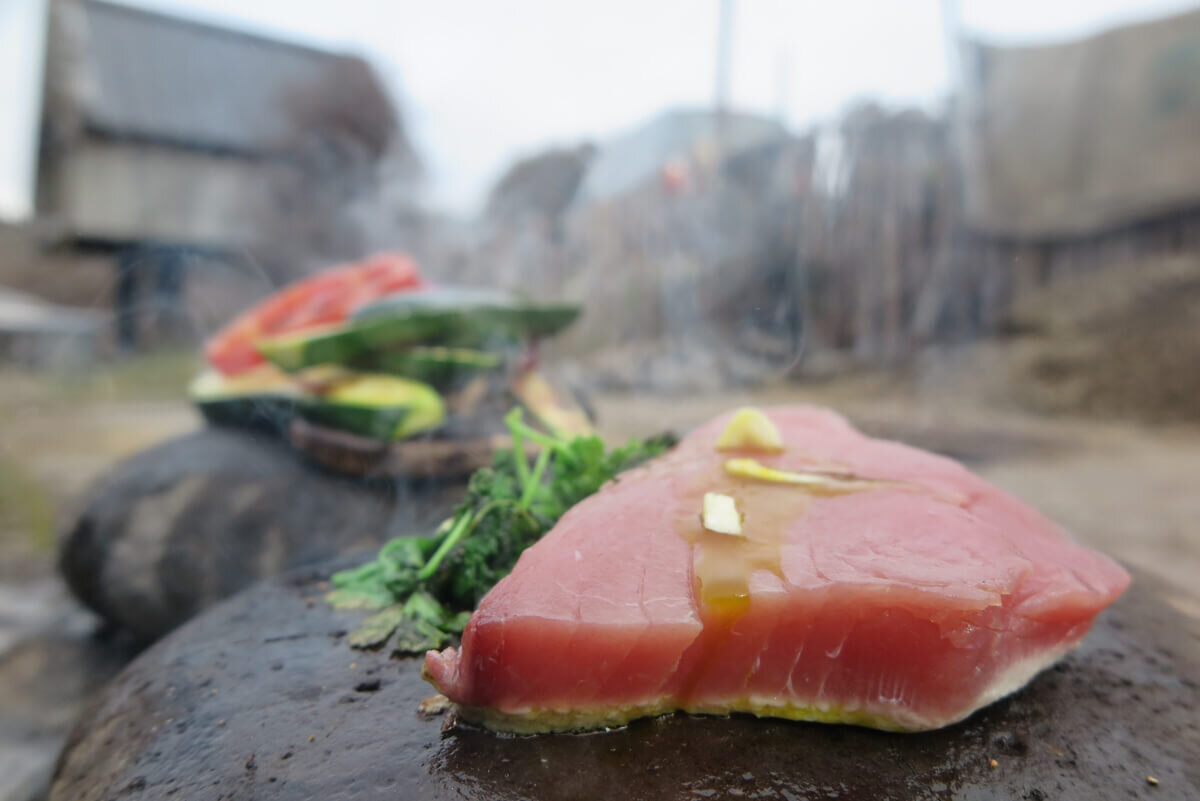
Kai refers to food in the Māori language, and it’s not just about what we eat, it’s a significant part of Māori culture and identity. Kai surrounds traditional foods such as kumara (sweet potato), fish, bird, and native plants that have been gathered for generations. It reflects the connection to the land and sea, highlighting the importance of sustainability and respect for nature in Māori customs.


How Do Māori Cook Their Kai?
Let's Cook Some Maori “Kai“. New Zealand's indigenous people — the… | by Slobodan Plavsic | New Zealand thoughts | Medium


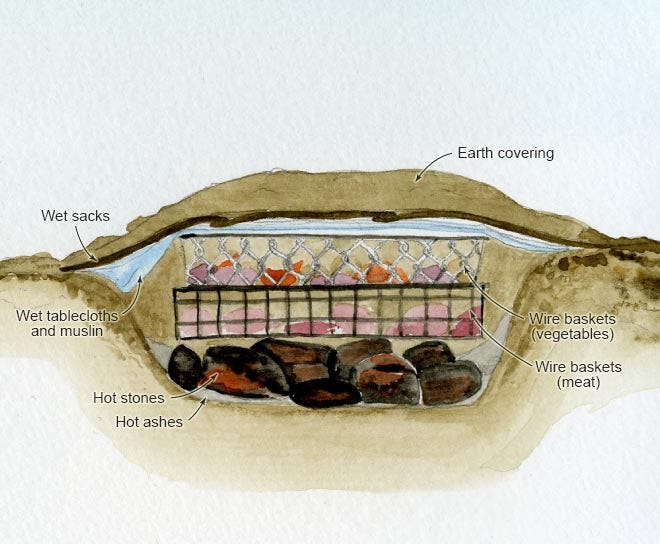
Māori have unique cooking methods that are deeply rooted in their traditions. One popular method is cooking food in an earth oven called a hangi. In a hangi, a pit is dug in the ground, heated with hot stones, and then covered with food wrapped in leaves. This method ensures that the food is steamed and infused with the flavours of the earth, creating a delicious and unique taste.


Interesting Aspects of Kai in Māori Culture

What I find particularly interesting about kai in Māori culture is the emphasis on community and sharing. When a meal is prepared, gathering family and friends to enjoy the kai together is common. This act of sharing food symbolises love, respect, and the bonds between people. Additionally, many traditional recipes have been passed down through generations, preserving not only the flavours but also the stories and traditions that come with them.


Reflection

During my concentration on these activities and the reading of the articles, I discovered new information that expanded my understanding significantly. I enjoyed the tasks presented, finding them both challenging and rewarding. The level I chose was comfortable as I chose the stage legend, which made the learning process all the more engaging.

Conclusion

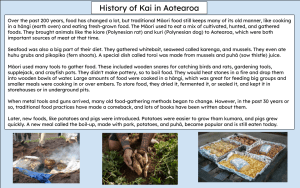
In conclusion, my learning about kai has opened my eyes to the rich cultural significance of food in Māori society. It’s not just about nutrition, it’s about community, history, and connection to the earth. I’m excited to continue exploring this topic and sharing what I learn with you all. Below, I’ve included my information poster about what I’ve learned about Kai.

Task
Thanks for reading

Shreeya

Ngā Kākahu – Clothing : Māori Class

Ngā Kākahu – Clothing

“Hello, everyone! Welcome back to my blog. I’m excited to share what we learned in my Māori class yesterday. We went into the world of different clothing types, such as jackets and t-shirts. It was quite an interesting session. The first task was to list these clothing items on our Edublogs, and I’ve included the words below. Exploring the vocabulary related to clothing was surprisingly enjoyable, and I found yesterday’s work quite fun.


In addition to learning about clothing, we also had a choice of different levels to work on: Ace, Pro, Legend, or Titan. I decided to go with the Legend level. However, I realized that it was not quite challenging enough for me, as I quickly finished it. Therefore, I’m looking forward to taking on the Titan level soon and sharing my progress on my blog.


Clothing words –

Te /  Tēnei –

ā ē ī ō ū

  • Jacket – Kōti
  • Hat – Pō tae
  • Skirt – Panekoti
  • Trousers – Tārau
  • Shorts – Tārau poto
  • Jeans – Tārau tāngari
  • Jersey – Poraka
  • Dress – Kaka
  • T-Shirt – tīhāte
  • Pjamas – Kākahu moe
  • Uniform – Kākahu ōrite
  • Swimming Togs – Kākahu kaukau


Ngā / Eenei –


  • Socks – Tōkena
  • Shoes – hū
  • Gloves – Karapu
  • Gumboots – Kamu pūtu
  • Glasses – Mōwhiti


Wetereo –


  • He aha – What
  • Tēnei – this ( 1 thing by me )
  • Eenei – these ( more than 1 thing by me )


  • He aha Tēnei? – What is this?
  • He aha ēnei? – What are these?


  • He kōti tēnei – This is a jacket
  • He kōti he tārau ēnei – These are a jacket and trousers


Mahi –

Legend Task –

Thank you for reading and viewing my work. It was a pleasure to have you visit my blog, and I hope you enjoyed it. Have a lovely weekend. Ahiahi mārie.

Shreeya


Maori Class – Ngā Tae/ Colours

Welcome back to my blog! It’s always a pleasure to have you here. Today, I am excited to share with you my experience in my Māori class. I’ve been taking this class for a few days now, and I must say, it has been a fantastic learning journey so far.


In our most recent class, we had a lesson on colours in Māori. I was a bit nervous at first, as I’ve always found remembering new words in a different language challenging. However, our teacher was fantastic, and the way she taught us made learning the colours in Māori a breeze.


We started with the basics, learning the colours of the rainbow. I was amazed at how beautiful the words sounded in Māori. We learned that red is “whero,” orange is “karaka,” yellow is “kōwhai,” green is “kākāriki,” blue is “kikorangi,” purple is “waiporoporo”, pink is “māwhero”, brown is “paraune”, grey is “kiwikiwi”, black is “mangu/pangu”, white which is mā, rainbow is “Uneuku and finally colours which is Ngā Tae.  As we went through each colour, we repeated them to our teacher, which helped us remember them better.


We learned the word “colour” in Māori, which is “Ngā Tae and then we learnt the word “rainbow” in Māori, which is “Uneuku.” We practised saying it a few times, and I must say, in the end, I got it.


Overall, I had a fantastic time in my Māori class today. I was delighted to discover that I could remember all the colours we learned, including the colours of the rainbow, the word “colour,” and the word “rainbow.” I’m looking forward to our next class, where I hope to learn more about this beautiful language and culture.


Reference – ( Click them to view )

Rewise colours


Como se usa google slides, 89% apagado venta de liquidacion - www.edgecontrolformen.com Checking the answers

What Is Canva And How Does It Work? Tips & TricksTask

Here is the task I did –

Task

Click the image to view the task or click above in the reference to see the task.


Thank you for taking the time to read my blog post. I appreciate your support and hope to see you in my next one!

Shreeya


Ngā tae – Colours

Welcome back to my blog. In Māori class today, we learned about colours and grammar. We learned all the colours of the rainbow and the word “rainbow” in Māori. The teacher wrote the word in English on the board and we had to answer in Māori. For the grammar part of the lesson, the teacher wrote some Māori words and we had to answer them, such as “he aha” which means “what”. We had to write sentences incorporating colours.


Our task was to choose between four levels: Ace, Pro, Legend, or Titan. Ace is the easiest level and is based on years 3-4, Pro is a little harder and is for years 5-6, Legend is hard and is for years 7-8, and Titan is also hard but has more details and is for year 9’s. I chose the Legend task, but my teacher suggested I should try the Titan task, as she believed I could do it.


Here are the different tasks that we could choose from:


Toroa-Titan Ruku-Legend Hāro-Pro Roimata-Ace
‘He aha te tae 

o tēra ahanoa? 

‘What colour 

is that object’ 

Before selecting this mahi, ensure you know all the colours in the quizlet and are confident using the ‘He aha te tae’ structure. 

Read through the structures on the first page and make your own notes. Complete the mahi on your blog. 

Mark your mahi when you finish

  1. Use either Quizlet or Wordwall to master the colour kupu. Spend about 5-10mins. 
  2. Hei Mahi– Work through Pg 40-41. Write out the question and the answer for ‘he aha te/ngā tae’ questions. Post your work to your blog. Mark. 
  3.  Ngā Tae Crossword. Once you have finished, screenshot your mahi and add it to your blog post. 
  1. Complete the Quizlet Match-Up in 30 seconds or less.
  2. Practice these kupu-words using Wordwall. Try at least 3 games.
  3. Hei Mahi Write out the question and the answer for each of the 8 pictures. Post your work to your blog. Mark.
  4. Collect a Colour by Number Superhero
  1. Complete the Quizlet Match-Up in a minute or less.
  2. Practice these kupu-words using Wordwall. Try at least 2 games.
  3. Collect a T-shirt colouring Page. Carefully colour the T-shirt to match the colour given in Māori.


Colours –

  • White – Mā
  • Red – Whero
  • Orange – Karaka
  • Yellow – Koowhai
  • Blue – Kikorangi
  • Purple – Waiporoporo
  • Green – Kākāriki
  • Pink – Māwhero
  • Brown – Parāne
  • Grey –  Kiwikiwi
  • Black – Mangu / Pangu
  • Rainbow – Uenuku

Wetero – Grammar

  • He aha – What?
  • te tae – the colour ( one )
  • Ngā tae – the colours ( More than one )
  • He aha + te tae? – What is the colour
  • He aha + ngā tae? – What are the colours?
  • He aha Kākāriki te tae – The colour is green
  • He kākāriki, he koowhai ngā tae – The colours are green + yellow.


Tasks I completed –

Link of activity

Crossword –

This is the crossword I had to do, this includes the colours, red, orange, yellow, green, blue, purple, pink, brown, white and black.


Reference – Click them to view the app

Responsive Google Slides ⁄ Chris Yee – Google slides

App of the Month: Quizlet - Diplomatic Language Services– Quizlet/ Flashcards

Wordwall– Wordwall


Thank you for taking the time to read this blog post. I hope you found it informative and enjoyable.

Shreeya

Numbers and Countings – Māori

Welcome back to my blog! Today in class, we did a challenging task of learning how to count in Māori. We practised counting things and people with great diligence and focus. Our teacher began the lesson by writing down some familiar words on the whiteboard, which we quickly recapped and practised. After that, the teacher introduced some new vocabulary, which we diligently copied. I am confident that we all performed exceptionally well in today’s lesson, and I hope you found it informative and engaging.

Counting Things –

E hia – How many? ( Not for people)

E hia ngā turu? – How many chairs?

E tekau mā rima ngā turu? – 15 chairs.

Hi ngā mataphi? – How many windows?

E rua tekau mā toru ngā matapihi – 23 windows.

E hia ngā papamā? – How many whiteboards?

Katahi te papamaā – 1 whiteboard.

Counting People – 

Tokohia – how many people?

Tokohia ngā tamariki? – How many chidren?

Tokohia ngā kōtiro? – How many girls?

Tokowhā ngā tamariki. – 4 children,

Tokoiwa ngā kōtiro. – 9 girls.

Tokohia ngā kaiako? – How many teachers?

 Kotahi te kaiako – 1 teacher.

Thanks for reading what I wrote! I just wanted to say that it’s really cool that you took the time to check it out. Your attention means a lot to me, and I hope that you found what I said interesting. If you have any questions comment down below or if you have feedback comment down below. Thanks again for reading!

Shreeya

He aha? — Māori class

Kia Ora, welcome back to my blog. Today in Māori we were learning how to say different words in Māori like, how to say morning, afternoon, and evening, how to say the time, etc. Here is what we did today and I hope you enjoy it.

Morning, afternoon, evening –

  • i te ata – in the morning.
  •  i te ahi – in the afternoon.
  • i te poo – in the evening.

Clock –

  • Karaka – o’clock
  • Hei aha te wā? – What time is it?
  • Half past – haurua


  • Quarter past – hauwhā i te ( past )
  • Quarter to – hauwhā ki te ( to )
  • He haurua i te ono karaka i te ata. – It’s 6:30 in the morning OR it’s half past 6 o’clock in the morning.
  • He hauwhā i te whā karaka i te ahi. – It’s quarter past 4 o’clock in the afternoon. OR it’s 4:15 pm.
  • He haurwhā ki te waru karaka i te poo. – It’s quarter to 8 o’clock at night. OR it’s 7:45 pm.

Question & answer

Question – He aha te wā?

Answer – He ono karaka i te ata.

In English – What is the time?

In English – It is 6 o’clock in the morning


Question – He aha te wā?

Answer – He whā karaka i te ahi.

In English – What is the time?

In English – It’s 4 o’clock in the afternoon


Question – He aha te wā?

Answer -He waru karaka it te poo.

In English – What’s the time?

In English – It’s 8 o’clock at night.


Practice work –

  • English – It is 3 o’clock in the afternoon
  • Māori – He toru karaka i te ahi.
  • English – It is 5 o’clock in the morning
  • Māori – He rima karaka i te ata.
  • English – It’s 7 o’clock at night
  • Māori – He whitu karaka it te poo.
  • English – It’s 4 am
  • Māori – He whā karaka ata.
  • English – It’s 6 am
  • Māori -He ono karaka ata
  • Māori – He whā karaka i te poo
  • English – It’s is four 0’clock in the morning

Thanks for reading

Shreeya

Aotearoa Place Names – Māori Class

Bonjour, welcome to my blog.

Yesterday in Māori, we had 2 tasks to complete. The first task was for 20 minutes and it was to connect a puzzle in Māori and English in the puzzle. It was so hard to do that we couldn’t even do it in 20 minutes.

After the puzzle, the second task was to name Aotearoa places in Māori, we and my friend Felice did this activity together, and we wrote the words in Māori and English to know what they meant.

We used a Māori dictionary if you want to know any Māori word just type the English word in the box and it will show the Māori word. If you want to try this out click on this link – Māori Dictionary.

Here is my task, hope you enjoy