Hello everyone, and welcome back to my blog. Today, we continued learning about energy. In this class, we were focusing on how rubber bands can store and release energy when launched. Our exciting project involved building catapults using various materials like popsicle sticks, spoons, and rubber bands, allowing us to see these energy principles in action. Each design choice affected how far and powerfully our catapults could launch objects, highlighting the fascinating interplay between potential and kinetic energy. I encourage you to try this fun experiment at home. It’s a great way to combine creativity with learning. I can’t wait to hear about your experiences and the impressive designs you come up with.
Aim: To make a catapult that uses electric and kinetic energy.
Materials:
- Popcical Stick (7)
- Rubber bands (at least 5)
- Spoon (1)
- Cotton ball (If you don’t have any available, you can make a small ball by crumbling some paper.)
- Small open area (One square meter will do it. It should be a sturdy flat surface, such as a table or floor.)
- Optional: Markers to decorate your popsicle sticks.
Steps
1. Prepare the Base: Take 6 popsicle sticks and stack them horizontally on top of each other. Ensure they are aligned properly for stability.

2. Secure the Sides: Use rubber bands to secure both ends of the stacked sticks. Wrap the rubber bands tightly around the ends to hold the sticks firmly in place.
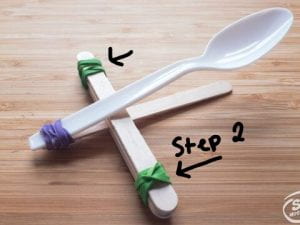
3. Add the Arm: Take another popsicle stick and place it vertically on top of the stack, making sure it’s centred. This will serve as the arm of your catapult.
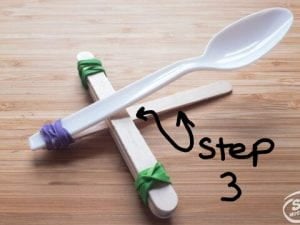
4. Cross-Lock It: Use two rubber bands to create an ‘X’ shape around the vertical stick and the horizontal stack. This will add extra support and stability to your catapult arm.
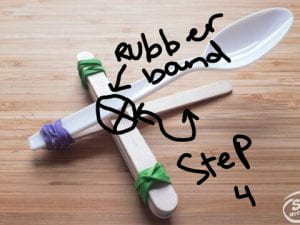
5. Attach the Spoon: Position a plastic spoon in the middle of the vertical stick. Ensure the bowl of the spoon is facing upwards.

6. Secure the Spoon: Use a rubber band to attach the spoon securely to the stick. Wrap the band around the spoon’s handle and the catapult arm for stability.
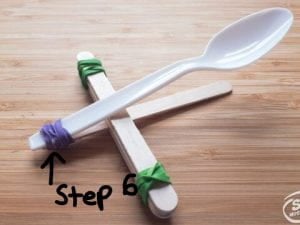
7. Catapult Complete: Your catapult is now assembled and ready for action! Enjoy launching small objects safely.

Different Energies –
Heat Energy –
- Fire
- Sun
Light energy –
- Torch
- Light Bulb
Sound Energy –
- Speaker
- Microphone
Gravitational Potential Energy –
- Dropping something
- Falling Objects
Electrical Energy –
- Solar Panels
- Microwave
Chemical Potential Energy –
- Petrol
- Batteries
Kinetic Energy –
- Dogs Running
- A picture frame falling from a wall
The Law of Conservation of Energy –
Energy can not be created or destroyed, but it can be transformed from one form to another. Scientists call this the “Law of Conservation of Energy”. Energy transformations cause all of the change that occurs around you.
For example, when you turn on your mobile phone, chemical potential energy in the battery is turned into electrical energy. The electrical energy is then turned into light energy for the screen, sound energy for the screen, and sound energy for the speaker. These changes can be summarised in every transformation.
Fill in the blanks –
a) Light bulb converts electrical energy to light energy.
b) Petrol motor converts chemical potential energy to kinetic energy.
c) Speaker converts sound energy to electrical energy.
d) Match converts chemical potential energy to heat energy.
e) Microphone converts electrical energy to sound energy.
f) Heater converts electrical energy to heat energy.
g) Kitchen mixer converts electrical energy to kinetic energy.
h) Jack in the box converts elastic potential energy to kinetic energy.
i) Ball moving upwards converts kinetic energy to gravitational potential energy.
Thansk for reading, that what we did in science class today, it was very fun.
Thanks
Shreeya