Year: 2025

Relief Music Activities || Music Class

Hello everyone, welcome back to my blog.

Today in music class, the teacher wasn’t here, so the relief teacher asked us to create some songs using Suno AI. After we finished our projects, we could choose to do some relief activities. Out of all the options, I completed two activities. One was about Diwali, and the other focused on movie music.

This blog post is dedicated to sharing what I learned from those two activities.

Enjoy!

Task –

Music Activities

Thanks, that’s all for this post

Bye, Shreeya


Liquids || Science Class

Hello everyone, welcome back to my blog. I’m excited to share my latest insights from science class. Today, we learnt about liquids. In this blog post, I’ll explore what I learned about liquids, their properties, and their importance in our everyday lives. From water to various types of beverages, liquids play a crucial role in countless processes and activities. Hope you learn something new today while reading this blog post.

Enjoy!


Learning Intention: Explore the properties of liquids


What is a liquid?

A liquid is a state of matter that can flow and take the shape of its container. Unlike solids, liquids do not have a fixed shape, but they do have a fixed volume


How do liquids behave?

Flow and shape

  • Liquids flow easily and can be poured
  • They always take the shape of the bottom of their container
  • Think of how milk spreads out in a bowl

Fixed Volume

  • Liquids keep the same amount, no matter the container
  • If you pour 100ml of juice into a cup or a bowl, it’s still 100ml
  • Liquids do not expand to fill the whole space like spaces


Properties of liquids

Can flow

  • Liquids move and can be poured from one place to another. This is called flowing

Takes Shape

  • liquids take the shape of their container but do not change their volume

Visible Surface

  • liquids have a clear, visible surface called the meniscus


Particles in liquids

In liquids, particles are close together but can slide around each other. This movement lets liquids flow and take the shape of their container.


Compare: Liquids and Solids

Liquid

  • Flows and takes the shape of its container
  • Fixed volume
  • Particles move past each other

Solids

  • Keeps its own shape
  • Fixed volume
  • Particles packed tightly, only vibrant


Experiment (if we did it)

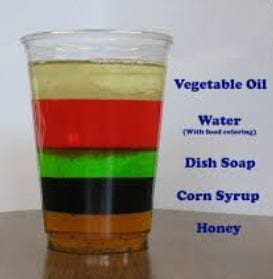
Aim: To look at why some liquids float on top of other liquids


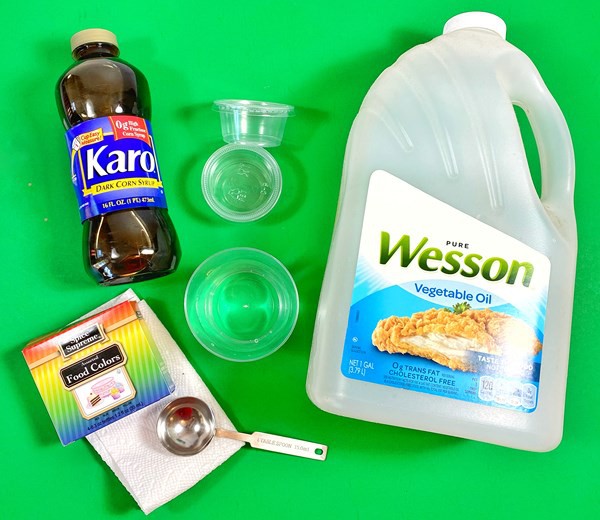
Materials:

  • Glass or cup
  • Tap water
  • Food colouring
  • Scissors
  • RUler
  • Rubber band (wide)
  • Small piece of wax
  • Craft stick
  • Small, clear jars or transparent mini cups (2~oz) with lids (at least 2)
  • Permanent marker
  • Masking tape
  • Small piece of Styrofoam
  • Tablespoons (3)
  • Dark corn syrup
  • Vegetable oil


Instructions:

  1. Take a clean tablespoon (tbsp) and pour 1 tablespoon of dark corn syrup into cup 1.
  2. With the second tablespoon, carefully pour 2 tbsp of coloured water into cup 1 on the tip of the corn syrup.
  3. Use the third clean tablespoon to pour 2 tbsp of vegetable oil into cup 1 on top of the coloured water
  4. Now take an empty cup 2 and add the same liquids, but reverse order. Start by pouring 2 tbsp of vegetable oil.
  5. Next, add 2 tbsp of coloured water on top.
  6. With a fresh tablesoon, carefully pour 1 tbsp of dark corn syrup into cup 2 on top of the water.
  7. Wait 1 or 2 minutes to let all the liquids settle in cups 1 and 2. Then look at both cups are compare how the different liquids are layered.
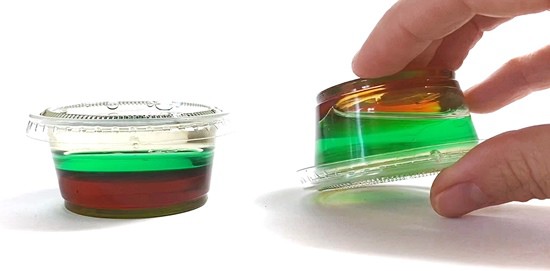
  8. Now take a cup 1 and close it with a lid. Carefully turn it upside down and set it on the table again. Observe the different liquids.
  9. Compare the upside-down cup 1 with cup 2 after a couple of minutes.
  10. Get all your cup-up objects and your penny ready, and drop the penny into cup 2
  11. Next, take the piece of rubber band and rip it into cup 2 with the craft stick, pushing the rubber band piece all the way down to the bottom of the cup. Make sure it does not stick to the bottom and can float freely.
  12. Now drop the piece of wax into cup 2 again, push the wax all the way down into the cup with the craft stick, but make sure it does not stick to the bottom or to the sides of the cup. It should be able to float freely.
  13. Last, take the piece of styrofoam and drop it into cup 2. Submerge it with the craft stick and wait for it to settle in one of the layers.
  14. Look at all four objects that you dropped into cup 2, and compare their locations.
  15. Finally, take cup 1, which is still upside down, and shake it really hard. Be sure to hold the lid tight. then pback on the table ( this time, right side up). Observe what happens for about 5 to 10 minutes

materials needed for stacking liquid density science activityTwo mini cups filled with dark corn syrup, green water, and vegetable oil are placed next to each other. A hand turns one of the mini cups upside down.

Rainbow Dish – Chromatography  (experiment)

Aim: To look at the density of skittles when mixed in water.

Materials: 

  • Pertri Dish
  • Water
  • Skittles

The experiment will be done in groups of 2. You will need to use the Skittles to see how the sugar in Skittles prevents them from mixing.


Method:

  1. I set up the experiment by placing all the skittles around the edge of the petri dish.
  2. Water was poured into the middle of the petri dish.
  3. I watched as the colours of the skittles flowed separately to form a colour wheel.


Thanks for reading

Shreeya

Speech || Literacy

Hello everyone, welcome back to my blog. Today, I want to share something with you. Over the last week of term 3 and now, ALT has been working on how to write a speech. To be honest, at first, I wasn’t sure if I could write one. But as I explored different topics, I found something that interested me: “Are social media influencers beneficial or harmful to society?” I believe this is a crucial subject that affects many of us, and I would love to hear your thoughts on it as well. So, for the task, I chose to place myself in legend from the four options (ace, pro, legend, titan).

Now, let me present to you my speech:

My Speech

Hello, my name is Shreeya, and today I’ll be exploring a topic that impacts nearly all of us, the influence of social media influencers on our society. Influencers are everywhere, shaping trends, opinions, and even values. While some use their platforms to raise awareness, promote positivity, and support good causes, others set unrealistic standards or spread misinformation. 

So are influencers a positive force, or are they doing more harm than good?

Let’s start wth the positives. Many influencers use their voice to promote important issues like mental health, climate action, and body positivity. They often connect with their audience in ways that media can’t. For example, activists like Greta Thunberg have mobilised millions online for climate justice. Educational influencers also share useful content on topics like science, finance, and well-being.

But not all influence is helpful. Many influencers promote an unattainable lifestyle or advertise products without transparency. This can lead to anxiety, low self-esteem, and misinformation, especially among younger followers. Some content may seem harmless, but it can encourage harmful habits or unrealistic beauty standards. 

This brings us to a key point with great influence comes great responsibility. Unfortunately, social media isn’t always well-regulated, making it easy for false or harmful content to spread. Some influencers face backlash for insensitive posts, but many continue unacknowledged.

So, overall, are social media influencers beneficial or harmful? The answer is they are harmful. They have the power to mislead and exploit. It’s up to us, the audience, to think critically. Before we like, follow or share, we should ask ourselves, is this person spreading truth and value or just chasing attention?


Hope you found my blog post informative and interesting.

Bye,

Shreeya

Solids || Science Class


What is a solid?

  • Defining a Solid

A solid is a shape of matter that keeps its shape and has a fixed volume.

  • Key features

Solids are hard to squash (compress). They don’t flow or spread out like liquids pr gases

In Te Reo Māori, totoka means solids.


Particle model of solids

  • How do solids hold their shape?

In a solid, particles are packed closely together in a fixed arrangement.

They vibrate but do not move from their places. This is why solids are rigid and strong.


Properties of solids

  • Fixed Shape: Solids do not change shape unless you force them. They are hard to bend or stretch.
  • Fixed Volume: Solids keep the same amount of space. They do not expand to fill a container.
  • Hard to Compress: You cannot squash a solid easily because its particles are tightly packed.

How to Identify Solids

Look at its shape: Does it keep its shape when moved or left alone?

Check its volume: Does it always take up the same amount of space?

Try compression: Is it difficult to squash or squeeze?


QUESTIONS!!

Question 1:

What is the Te reo Māori term for a solid? Totoka

Question 2:

Name two key properties that all solids share. Fixed Shape and Fixed Volume

Explain why it is difficult to compress a solid. Because a solid is made up of little particles tightly pressed together. The force holds the particles in place, keeping the solid’s volume and shape.

Matter || Science Class


What is matter?

Matter is everything around us!

Matter (matu) is anything that has mass and takes up space (volume). Everything you can see, touch, smell, or taste is made of matter. Even things you can’t see, like air (hau), are matter

Examples: water (wai), rocks (toka), air (hu, and your own body (tinana).


States of matter

Solids:

Solids keep their shape and have a fixed volume.

Example: Ice

Four things of solids:

  • Chair
  • Laptop
  • Table
  • Pencil


Liquid:

Liquids flow and take the shape of their container.

Example: Water

Four things of liquid:

  • Coca Cola
  • Water
  • Milk
  • Oil


Gas:

Gases spread out to fill any space.

Example: Air

Four things of Gas:

  • Hydrogen
  • Smoke
  • Laughing Gas
  • Steam


What are atoms?

  • All materials on earth, such as plastic, wood and rock, are made of atoms, with empty spaces between them.
  • Atoms are the smallest substance.
  • The smallest bunch of atoms is called a molecule.
  • Scientists call bunches of molecules matter.
  • There are 118 different types of atoms on Earth. These are listed on the periodic table of elements.


Characteristics of matter

  • We cannot create new matter, and we cannot destroy matter, but atoms can be rearranged
  • The amount of matter(atoms) in a substance is called its mass. Because matter is just lots of atoms and can be weighed.
  • If atoms are packed very tightly together, they have more mass (a greater number of atoms in a given space) and therefore weigh more. They are said to be dense.


Protest and Change || Social Studies

Hello everyone, and welcome back to my blog. I’m excited to share what my class, AlT, has been learning about over the past week. We’ve been exploring the concept of protesting. For those unfamiliar with it, protesting is a public demonstration that expresses dissent or objection to specific policies, actions, or social issues. It’s a way for people to come together, often in a designated location, to advocate for change and increase awareness about the matters that matter to them.

Our recent task was particularly engaging and involved creating a poster that highlights a specific type of protest. We were required to outline what this protest is, why people choose this method, and whether it’s effective, essentially, does it truly work?

Protesting can take many forms, from peaceful marches and rallies to more unconventional methods like sit-ins or online advocacy. Each type serves a unique purpose and can resonate differently based on the audience. Through this project, we’ve not only learned about the mechanics of protests but also about their historical significance and their impact on society.


My Poster Task

Thanks for reading,

Shreeya

Listening Skills Part 2 || Science Class

Hello everyone, welcome back to my blog. Today in science, we did another listening test where the teacher said some numbers and words and typed them in our blog. We couldn’t type them when he said them, or else that would be cheating, so we had to remember them for 5 seconds after he said them. It was kind of hard but enjoyable, and I have good listening skills as I got them all right. That’s all I have for this blog. Bye!

Numbers –

  1. 3,1,2,5,4 (correct)
  2. 6,4,2,6,8 (correct)
  3. 5,6,4,7,8 (correct)
  4. 2,8,4,3,8 (correct)
  5. 5,6,8,5,3 (correct)
  6. 1,5,7,2,1,2 (correct)
  7. 2,5,9,6,4,2 (correct)
  8. 5,9,0,7,1,3 (correct)
  9. 3,7,6,4,3,2 (correct)
  10. 1,9,6,5,3,2 (correct)


Words –

  1. Elephant, Lepord, Cheetah, Lion, Tiger – Lepord (correct)
  2. Rugby, Football, Rugby, Netball, Hockey – Football (correct)
  3. Rain, Hail, Snow, Sleet – Hail (correct)
  4. Seagull, Chicken, Sawrrow, Eagle – Seagull (correct)
  5. Blue, Red, Yellow, Black – Blue (correct)
  6. New Zealand, Australia, Fiji, Samoa, Africa – Fiji (correct)
  7. Guitar, Piano, Violin, Ukulele, Recorder – Guitar (correct)
  8. Tahi, Wha, Whitu, Iwa, Rua – Whitu (correct)
  9. Jeans, Shirt, Hat, Socks, Trouser – Shirt (correct)
  10. Kakariki, Koiwhai, Whero, Ma, Pango – Koiwhai (correct)

Conservation Efforts Part 2 || Science Class

Hello everyone, and welcome back to another blog post for science.
Today, I delved into an important topic in the realm of science: conservation efforts aimed at protecting our wildlife and ecosystems. We explored how reducing pollution, promoting recycling, and supporting clean energy initiatives can help safeguard our planet. I emphasised the critical role of government and major organisations in creating protected areas for wildlife and enforcing laws against poaching and habitat destruction. Finally, I discussed the legal frameworks in place, such as the Wildlife Act 1953, which outlines protections for different species across New Zealand. Join me as we navigate these essential conservation efforts and their impact on our environment.

Protecting animals within an ecosystem

To protect habitats and ecosystems from serious harm, we need to focus on reducing pollution and conserving natural resources. This can be achieved by using less plastic, recycling more, and supporting clean energy solutions. It’s also important to create protected areas where wildlife can thrive without human interference. Finally, educating others about the importance of preserving our environment will help everyone work together to keep our planet safe.


Can the government or major groups help protect animals that live there?

Yes, the government and major groups can play a big role in protecting animals. They can create protected areas like national parks or reserves where animals can live safely away from threats. Additionally, they can enforce laws against poaching and habitat destruction to help keep animal populations stable. Working together, they can also raise awareness about the importance of preserving wildlife and their habitats.


Legal Protection

Wildlife Act 1953

The Wildlife Act is the main law that helps protect animals classed as wildlife, including some of New Zealand’s most endangered species. 

The Act does this by controlling how people interact with wildlife.

It protects them in three ways:

  1. Absolute protection
  2. Varying protection
  3. No protection


Absolutely protected wildlife

If an animal is absolutely protected, it means that without a permit from DOC, it’s an offence to:

  • Catch, hunt or kill it
  • Buy, sell or own it
  • Hold it in captivity
  • Release it
  • Export it

The protection applies whether the animal is alive or dead, and to all or parts of it, for example, feathers, skin, bones, and eggs.


Examples of absolutely protected wildlife

kiwi, kea, blue duck/whio, tūī, fantail/pīwakawaka, terns, albatross/toroa, tuatara and Wētā.


Varying protected wildlife

Some wildlife species are protected, but not absolutely. They may be killed in specific circumstances. These species are listed in schedules within the Act.


  1. Game hunting during hunting season. Hunters must have a special licence.
  2. Hunted because they are destroying land and other habitats.
  3. Hunted with a special cause: Māori can hunt muttonbirds but only in special circumstances.


Unprotected Wildlife

Some of these unprotected wildlife species cause harm, for example:


  1. Predators on threatened native species, for example, stoats, feral cats, and hedgehogs
  2. Eating native plants, for example, wallabies
  3. Causing damage to farms or orchards, for example, possums, Canada geese, rooks, or to people’s homes, for example, rats, mice
    1. Causing risk to people’s safety through bird strikes at airports, for example, the  spur-winged plover, black-backed gulls

These can all be killed under these conditions only.


Thanks, that’s all for my science blog today. I hope you enjoy it and find this blog post informative

Bye,

Shreeya


Conservation Efforts || Science Class

Hello everyone, welcome back to my blog. Today, I’m excited to share some important insights about the fragile relationship between humans and our planet. As we navigate the complexities of modern life, it’s crucial to take a step back and reflect on our role as stewards of the Earth. With increasing environmental challenges, from climate change to habitat loss, understanding the significance of protecting our ecosystems and waterways is more vital than ever. Join me as we explore why conservation matters and how we can collectively make a difference for future generations.


Why is it important to protect our planet?

Protecting our planet is essential for the sustainability of life. The Earth provides vital resources such as clean air, fresh water, and fertile soil, all of which are necessary for human survival and well-being. Additionally, a healthy planet contributes to biodiversity, which helps maintain ecological balance and resilience against climate change. Our actions impact the environment, so safeguarding it ensures that future generations can inherit a thriving world.


Why protect the ecosystems?

Ecosystems are complex networks where living organisms interact with each other and their physical environments. Protecting these ecosystems is crucial because they provide essential services, such as food production, pollination, climate regulation, and natural pest control. Healthy ecosystems support biodiversity, which strengthens resilience against diseases and environmental changes. Moreover, they contribute to cultural, recreational, and economic benefits for communities.


Why protect our waterways like streams and rivers?

Waterways are vital for all forms of life. They provide drinking water, irrigation for agriculture, and habitats for various species. Protecting streams and rivers helps maintain water quality, preventing pollution that can harm both wildlife and human populations. Healthy waterways also support recreational activities, enhance local economies, and mitigate flooding by allowing natural water flow and absorption. Safeguarding these resources ensures the sustainability of surrounding ecosystems and the communities that rely on them.


What’s so important about them?

Streams, rivers, and their ecosystems play a crucial role in the Earth’s hydrological cycle, impacting weather patterns and climate. They are essential for biodiversity, serving as habitats for countless species, some of which are endemic and cannot survive anywhere else. The health of waterways is often an indicator of overall environmental quality, reflecting the state of the ecosystem in which they exist. By protecting these areas, we not only conserve natural beauty and resources but also ensure the health and vitality of our planet for generations to come.


What can we do to help?

There are many things we can do, but we will look at three ways

  1. Habitat Restoration – Restore the habitat to what the species originally had.
  2. Legal protection – getting government and international support to protect the species.
  3. Recycle, reuse, refuse – reduce the amount of waste in waterways and in landfills.

Habitat restoration

Our planet’s biodiversity is facing serious challenges, including a rapid, massive loss of wildlife. 

It is up to us to reverse the damage and rebuild ecosystems to their former health, functionality and diversity. 

This repair process is known as habitat restoration.


Task

Department of Conservation – Mata-Au Clutha River Freshwater Enhancements

This is where I got the info from


And here are the questions

1. How are they restoring the habitat?  

The habitat is being restored through planting projects aimed at enhancing native freshwater fish habitat. Contact Energy implemented multiple planting sites within the Mata-Au Clutha River catchment as part of their resource consent for hydro-electric facilities. They collaborated with the Department of Conservation (DOC) for plant selection and site information. Large grade plants were sourced and planted directly in rank grass without the use of chemicals or site preparation, which helps revitalise the habitat for native fish species.


2. What kind of habitat is it?

The habitat being restored is a freshwater ecosystem along the Clutha River/Mata-Au, which includes vital areas for native fish populations such as giant kokopu, tuna, kanaka, and inaka (whitebait). This ecosystem is characterised by its complex interactions within the aquatic and riparian zones, providing essential breeding sites, food resources, and shelter for various species.


3. Where is this happening?

This restoration effort is taking place within the lower Clutha River/Mata-Au catchment, specifically at multiple planting sites, including locations such as Waitahuna, Elliotvate, Kouau branch, Riverside Farm, and others associated with the river’s ecosystem. The region has historical significance as well, being a traditional mahinga kai trail for Tāngata whenua and a site associated with gold mining and electricity generation.


Thanks for reading,

Shreeya
Listening Skills || Science Class

Hello everyone, today we were doing listening skills. The teacher called out some numbers, then some words, and we had to write them down. He said the words so fast, which was my test of listening. Then we learnt a bit about Fossil fuels. That’s all I have. Bye!


  1. 1,2,5,4 ✅
  2. 4,2,6,8 ✅
  3. 6,4,7,8 ✅
  4. 8,4,3,8 ✅
  5. 6,8,5,3 ✅
  6. 5,7,2,1,2 ✅
  7. 5,9,6,4,2 ✅
  8. 9,0,7,1,3 ✅
  9. 7,6,4,3,2 ✅
  10. 9,6,5,3,2 ✅


Fish, Duck, Lion, Tiger – ✅

Duck, Lion, Tiger

Fish is missing

Rugby, Hockey, Bowls, Football – ✅

Rugby, Hockey, Bowls

Football is missing

Pencil, Pen, Ruler, Rubber – ✅

Pencil, Ruler, Rubber

The pen is missing

Seagull, Chicken, Sparrow, Goose – ✅

Chicken, Sparrow, Goose

Seagull is missing

Blue, Red, Yellow, Black – ✅

Red, Yellow, Black

Blue is missing

New Zealand, Australia, Fiji, Samoa, Africa – ✅

New Zealand, Australia, Samoa, Africa

Fiji is missing

Guitar, Piano, Violin, Recorder, Ukulele – ✅

Piano, Violin, Recorder, Ukulele

The guitar is missing

Hot, Cold, Up, Down, Big – ✅

Hot, Cold, Up, Big

Down is missing

Kakariki, Kowhai, Whero, Ma – ✅

Kakariki, Whero, Ma

Kowhai is missing

Hornby, Linwood, Hilmorton,  Brighton, Sumner – ✅

Hornby, Hilmorton, Brighton, Sumner

Linwood is missing


Fossil Fuels

Fossil Fuels are fuels that are made of decomposed organic matter. These take a long time to make.

Example: 

  1. Coal
  2. Oil
  3. Natural Gas


Thanks,

Shreeya